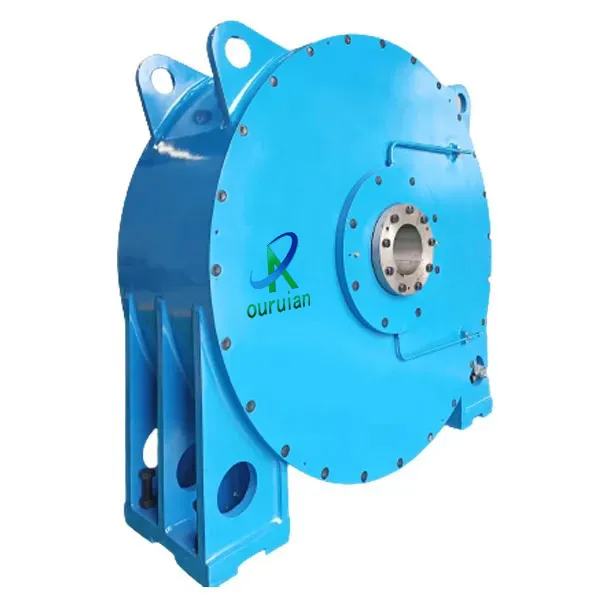
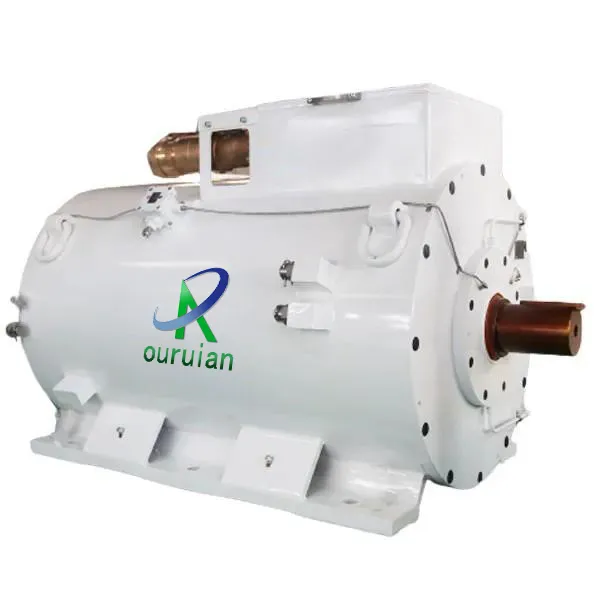
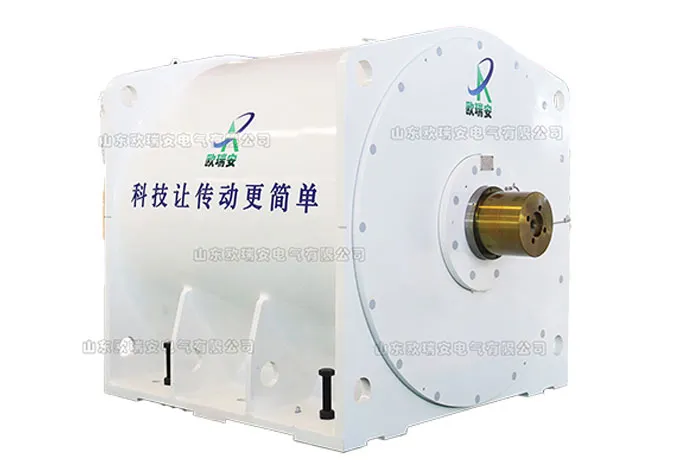
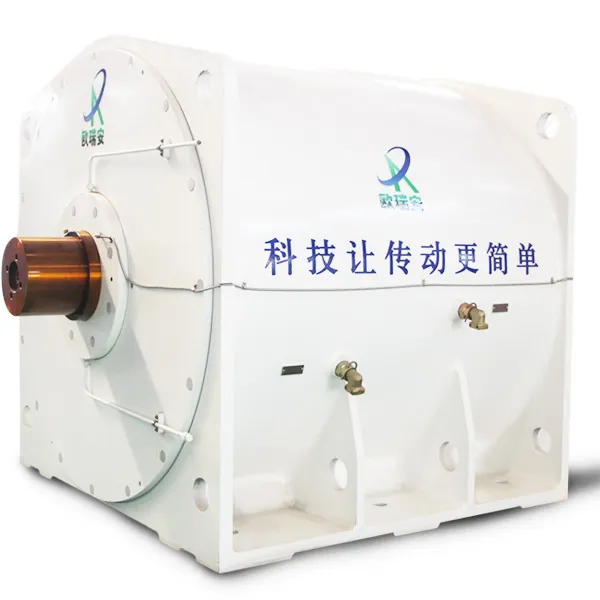
Remote power sites — wind, hydro, off-grid industrial loads, mining camps, and island microgrids — pay a premium for downtime. Travel time, spare parts logistics, and limited technician availability turn small failures into long outages. A gearless permanent magnet synchronous generator reduces mechanical complexity by removing the gearbox, lowering routine service needs and improving reliability in harsh environments. This guide explains the maintenance and ROI logic, plus what to confirm before you PMSM buy for remote-generation projects.
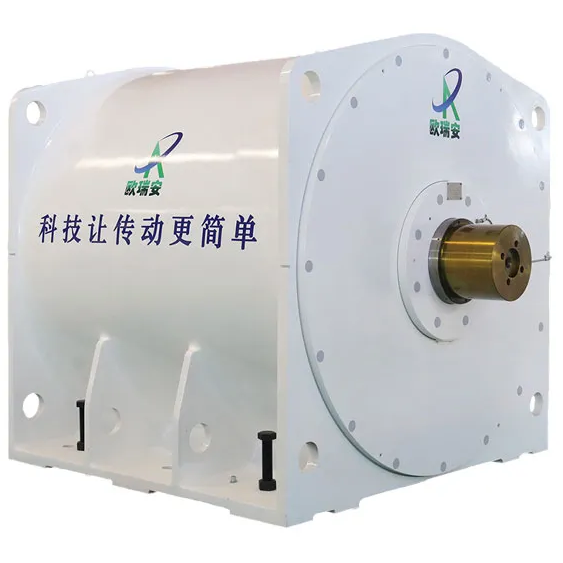
PMSM Buy Decision: Why Gearboxes Drive Maintenance Cost in Remote Systems
The Gearbox Maintenance Problem
A gearbox is a collection of wear mechanisms — each one requiring attention on a defined schedule, and each one capable of causing a failure if that schedule slips.
| Gearbox Maintenance Item | Frequency | Remote-Site Complication |
|---|
| Lubricating oil change | Every 1,000–2,000 operating hours | Requires oil transport, disposal, and scheduled technician visit |
| Seal inspection and replacement | Annual or condition-based | Early seal failure causes oil contamination and accelerated wear |
| Gear tooth wear inspection | Annual | Requires equipment access and trained inspector |
| Bearing replacement | Every 3–5 years depending on load | Precision work; specialized tooling required |
| Alignment check | After any significant load or thermal event | Misalignment accelerates all other wear mechanisms |
| Oil sampling and analysis | Quarterly | Logistics challenge in remote locations without laboratory access |
The Remote-Site Penalty
In an accessible location, a gearbox oil change is a routine morning job. At a remote wind site accessible only by helicopter, or a run-of-river hydro generator accessible only by boat during certain seasons, the same job requires flight coordination, weather windows, and hourly logistics costs that can multiply the service cost by 5 to 20 times.
Every gearbox failure event at a remote site has three cost layers: the repair itself, the lost generation during downtime, and the logistics of getting the right people and parts to the location.
Permanent Magnet Synchronous Generator: How Gearless PM Generators Produce Power
Operating Principle
A permanent magnet synchronous generator uses permanent magnets embedded in or mounted on the rotor to provide the magnetic excitation field. As the rotor turns — driven directly by the prime mover — the rotating magnetic field induces voltage in the stator windings. Power is generated without external excitation, slip rings, or brushes.
| Characteristic | Wound-Rotor Generator | Permanent Magnet Synchronous Generator |
|---|
| Excitation source | External DC supply via slip rings | Permanent magnets — no external source needed |
| Slip rings and brushes | Required | Not present — eliminates associated maintenance |
| Efficiency at part load | Lower | Higher — no excitation copper loss |
| Rotor maintenance | Slip ring cleaning, brush replacement | Bearings only |
| Speed-torque flexibility | Good | Excellent — high torque at low speed enables direct drive |
Why Gearless Is Possible with PM Design
The key enabler is high torque density at low speed. A permanent magnet synchronous generator can be designed to produce rated torque at the direct drive speed of the prime mover — typically 50–300 RPM for wind turbines and small hydro — without requiring speed multiplication through a gearbox.
The tradeoff is that the generator is physically larger in diameter (more poles needed at low speed), but this is an acceptable engineering tradeoff when the alternative is a gearbox maintenance program at a remote site.
Power Electronics in the System
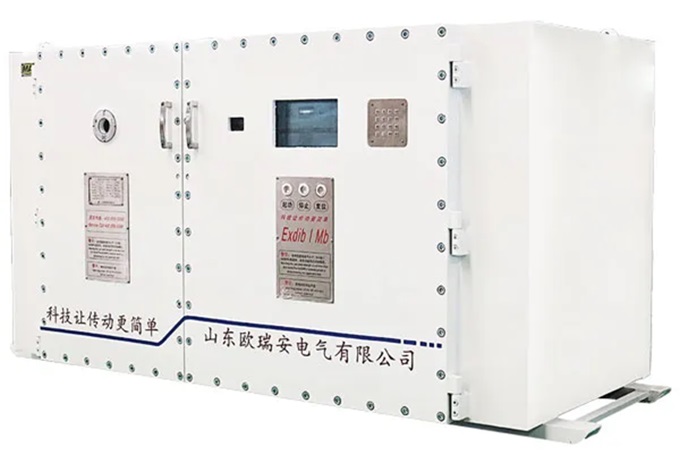
Variable-speed prime movers — wind turbines, run-of-river hydro with fluctuating head — require power electronics to convert the variable-frequency AC output to grid-compatible or stable DC power. A rectifier converts the generator AC output to DC; an inverter converts back to grid-frequency AC. This adds electronic components to the maintenance picture, but electronics are more tolerant of remote environments than mechanical gearboxes and have no lubrication requirement.
PMSM Buy for Remote Environments: Reliability Advantages and What Still Needs Attention
What Typically Improves Without a Gearbox
| Failure Mode | Geared System | Gearless PM Generator |
|---|
| Oil seal failure | Common | Eliminated |
| Gear tooth pitting or spalling | Possible | Eliminated |
| Oil contamination event | Possible | Eliminated |
| Alignment-induced bearing overload | Common | Reduced — fewer shaft connections |
| Vibration from gear mesh harmonics | Present | Eliminated |
| Lubrication system failure | Possible in complex gearboxes | Eliminated |
What Still Requires Maintenance
Removing the gearbox does not eliminate all maintenance — it changes what needs attention.
| Maintenance Item | Interval | Notes |
|---|
| Bearing inspection and replacement | 5–10 years depending on load and speed | Critical — bearings are the primary remaining wear component |
| Cooling system service | Annual or per-manufacturer guidance | Air or liquid cooling; filters, fans, or pumps require attention |
| Winding insulation monitoring | Condition-based | Insulation aging in high-humidity or high-temperature environments |
| Electrical connections inspection | Annual | Vibration and thermal cycling loosen connections over time |
| Condition monitoring sensor calibration | Annual or per-sensor specification | Temperature, vibration, and partial discharge sensors |
Remote-Readiness Features to Specify
IP65 or higher enclosure for dusty, wet, or salt-air environments
Bearing temperature sensors with remote monitoring output
Vibration sensors on drive-end and non-drive-end bearings
Corrosion protection on external surfaces and terminal boxes
Sealed winding insulation rated for the ambient humidity and temperature range
Permanent Magnet Synchronous Generator TCO: Downtime Savings vs. Higher CAPEX
TCO Comparison Framework
| Cost Category | Geared Conventional Generator | Gearless PM Generator |
|---|
| Initial equipment cost | Lower | Higher — larger diameter generator |
| Annual scheduled maintenance | Higher — gearbox oil, seals, filters | Lower — bearings and cooling primarily |
| Unplanned downtime probability | Higher — gearbox failure modes add risk | Lower — fewer mechanical failure modes |
| Logistics cost per service visit | Same or lower (simpler tooling) |
|
| Downtime cost per event | High — remote logistics | Reduced frequency partially offsets cost |
| 20-year maintenance cost | Higher | Lower — depending on site logistics premium |
Simple ROI Logic for Remote Sites
The financial case for a gearless permanent magnet synchronous generator at a remote site is built on two numbers: the cost per outage hour and the expected reduction in outage frequency.
If a remote wind site loses USD 2,000 per hour of downtime and a gearbox failure causes an average of 120 hours of lost generation twice per decade, the gearbox failure cost alone exceeds USD 480,000 over 20 years. If the gearless design eliminates the majority of gearbox-related failures, the CAPEX premium of USD 50,000–150,000 for a larger direct-drive generator is recovered quickly.
Project Planning for Minimum Lifecycle Cost
Spares strategy: hold one bearing set for each machine as on-site spare; agree on manufacturer stock-holding for longer-lead items
Service intervals: align bearing inspection with other site maintenance activities to minimize trip frequency
Training: local technicians can perform bearing and cooling service without specialist gearbox knowledge
PMSM Buy Checklist: Specs to Confirm Before Choosing a Gearless PM Generator
Technical Specification Inputs
| Parameter | What to Define | Why It Matters |
|---|
| Rated power (kW) | Continuous output at design point | Generator sizing — not prime mover nameplate |
| Speed range (RPM) | Minimum, rated, and maximum operating speed | Direct-drive pole count and generator diameter |
| Torque at rated speed | Nm at the operating point | Confirms the generator can be direct-coupled |
| Output voltage and frequency | Grid voltage or DC bus level | Determines rectifier/inverter specification |
| Duty cycle | Continuous, intermittent, or variable | Thermal sizing — particularly for remote low-cooling sites |
| Ambient temperature range | Minimum (cold start) and maximum continuous | Winding insulation class and cooling design |
| Environmental classification | Humidity, salt fog, dust level, altitude | IP rating, corrosion protection, derating |
| Cooling method | Self-ventilated, forced air, or liquid | Remote site — cooling system maintenance must be considered |
Electrical and Controls Requirements
Confirm whether variable-frequency output is acceptable or whether power electronics are required for grid connection
Confirm grid code requirements if the generator will export to a utility network
Specify monitoring interface — MODBUS, CAN, Ethernet — for integration with site SCADA or remote monitoring platform
Acceptance Testing Plan
Efficiency curve measurement at multiple load points — not nameplate only
Temperature rise test at rated continuous duty — confirm thermal margins before remote deployment
Insulation resistance test — confirm winding condition before shipping
Vibration and balance verification — confirm rotor balance grade for the operating speed range
Conclusion
In remote locations, reliability is a cost strategy. A gearless permanent magnet synchronous generator can reduce maintenance overhead by eliminating gearbox service requirements and minimizing the mechanical failure modes that are most expensive to address far from infrastructure. If you are planning to PMSM buy for a remote power project, the best outcomes come from correct power and speed sizing, specifying environmental protection appropriate for the site, planning condition monitoring for bearings and electronics, and building a practical spare-parts strategy before deployment.
FAQ
Q1: What is a permanent magnet synchronous generator?
It is a generator where permanent magnets on the rotor provide the magnetic excitation field without slip rings or brushes. As the rotor turns, the rotating magnetic field induces voltage in the stator windings, producing electrical power. The absence of external excitation makes it simpler and more efficient, particularly at part load.
Q2: Why does removing the gearbox reduce maintenance costs?
Gearboxes require regular oil changes, seal inspection and replacement, gear tooth condition monitoring, and alignment checks — all of which become expensive at remote sites due to logistics costs. Eliminating the gearbox removes all these maintenance items and the associated failure modes from the maintenance schedule.
Q3: Do gearless PM generators require zero maintenance?
No. Bearings remain the primary wear component and require condition monitoring and periodic replacement. Cooling systems need service attention. Electrical connections require inspection for vibration-induced loosening, and winding insulation condition should be monitored in harsh environments. The maintenance program is simpler and less frequent — not eliminated.
Q4: Is a gearless PM generator always more expensive upfront?
The equipment cost is typically higher because the generator must be larger in diameter to achieve rated torque at low direct-drive speed. However, total cost of ownership over 20 years at a remote site is frequently lower once the reduction in gearbox service visits and failure events is quantified against the remote-site logistics cost per maintenance event.
Q5: What information is needed before a PMSM buy decision for a remote power project?
Rated power output requirement, operating speed range including minimum and maximum, required output voltage and frequency, duty cycle, ambient temperature range and environmental classification for the site, cooling method constraints, and whether variable-speed power electronics are required for the application. These parameters define both the generator and the power electronics scope simultaneously.
 English